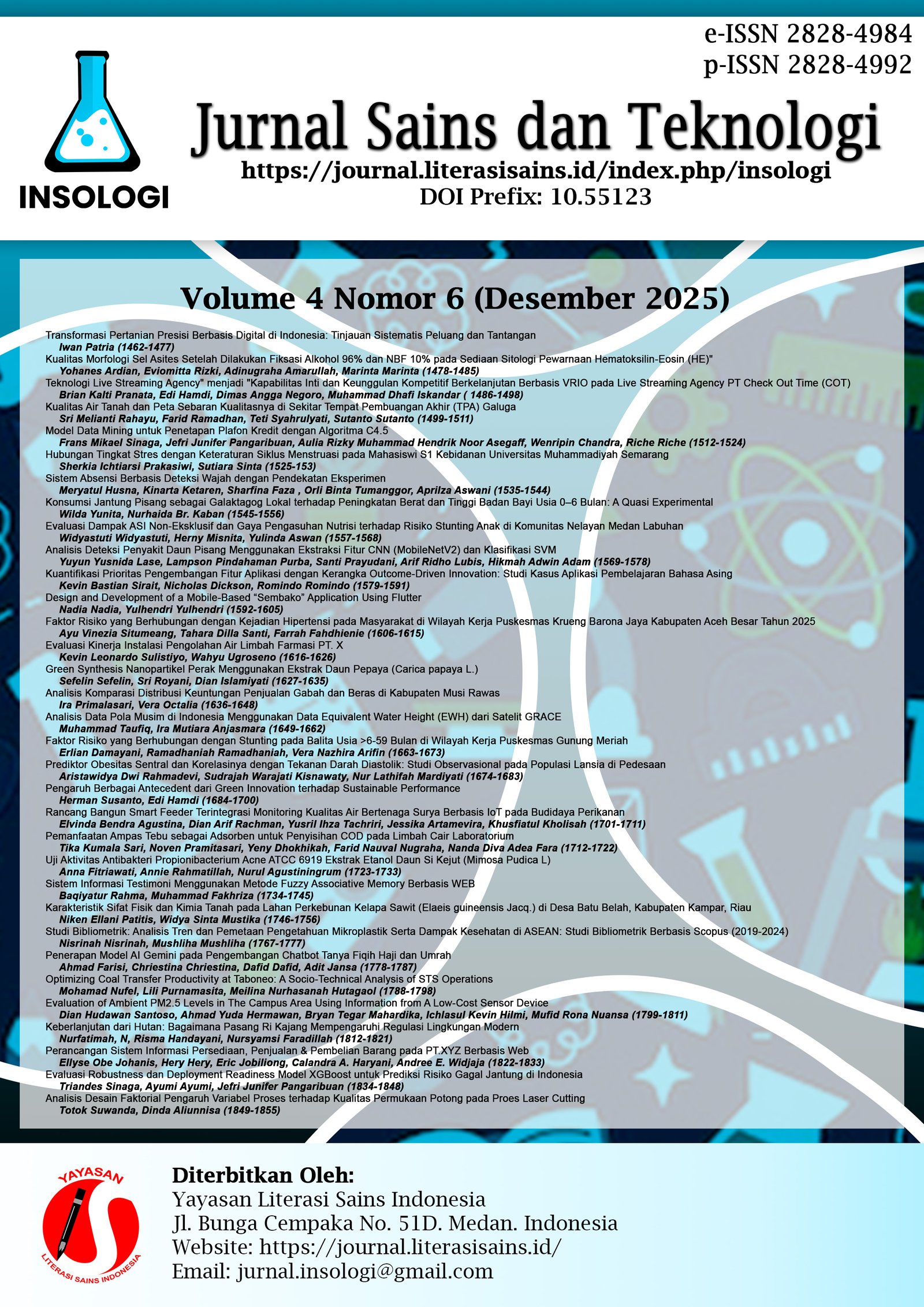
Konsumsi Jantung Pisang sebagai Galaktagog Lokal terhadap Peningkatan Berat dan Tinggi Badan Bayi Usia 0–6 Bulan: A Quasi Experimental
DOI:
https://doi.org/10.55123/insologi.v4i6.6683Keywords:
Banana Blossom, Breastfeeding, SuperfoodAbstract
The banana blossom has significant potential as a local superfood that can enhance both the production and quality of breast milk (ASI). Its nutritional components—including plant-based proteins, fiber, minerals, and phytonutrients—make it a safe, natural, and easily accessible alternative source of nutrition across various regions of Indonesia. This study is particularly important given the persistently high prevalence of nutritional problems among infants and the low rate of exclusive breastfeeding in the country.The development of banana blossom–based food innovations is expected to serve as an effective strategy to strengthen household food security and address nutritional challenges among vulnerable groups, particularly breastfeeding mothers and infants in their early stages of life. The purpose of this study is to examine the potential effects of banana blossom consumption on optimizing the growth and development of infants aged 0–6 months. This research employs an experimental design using a pre–post-test control group method. The participants consist of 40 breastfeeding mothers with infants aged 0–6 months within the working area of Puskesmas Stabat, Medan. The intervention group received banana blossom consumption every three days for four weeks. The results show that banana blossom consumption had a significant effect on increasing infants’ weight and height, indicating its potential contribution to sustainably improving infant nutritional status.
Downloads
References
Ahmed, M., Rahman, A., & Karim, S. (2023). Exclusive breastfeeding and infant growth patterns: A cohort study in South Asia. International Journal of Pediatrics and Adolescent Medicine, 10(2), 85–92. https://doi.org/10.1016/j.ijpam.2023.02.004
Astari, R., & Hardianti, D. (2022). Efektivitas konsumsi jantung pisang terhadap peningkatan produksi ASI pada ibu menyusui. Jurnal Kesehatan Reproduksi, 13(1), 45–52. https://doi.org/10.20473/jkr.v13i1.2022
Febriani, W. (2024). Proximate analysis of fresh banana blossoms and banana blossom flour: Implications for product development. IJCBS / iScientific (Conference Paper). https://iscientific.org/wp-content/uploads/2024/05/22-IJCBS-24-25-19-22.pdf
Gunathilake, K. D. P. P., Ranaweera, K. K. D. S., & Rupasinghe, H. P. V. (2018). Effect of Different Cooking Methods on Polyphenols, Carotenoids and Antioxidant Activities of Selected Edible Leaves. Antioxidants, 7(9), 117. https://doi.org/10.3390/antiox7090117
Hake, R. R. (1999). Analyzing change/gain scores [Unpublished manuscript]. Indiana University. http://www.physics.indiana.edu/~sdi/AnalyzingChange-Gain.pdf
Hastuti, N. T., & colleagues. (2024). Comparison of oxytocin massage and banana flower consumption in increasing breast milk volume. International Journal of Healthy Nursing (IJHN). https://ijhn.ub.ac.id/index.php/ijhn/article/view/737
Iis Ismawati, Nay Lufar, & Nayya Aqnia Rahma. (2024). The influence of banana blossom consumption on breast milk production in postpartum mothers. Politeknik Kesehatan Harber (Poltek Harber). https://ejournal.poltekharber.ac.id/index.php/siklus/article/download/8003/pdf
Kementerian Kesehatan Republik Indonesia. (2023). Survei Status Gizi Indonesia (SSGI) 2022: Laporan Nasional. Kementerian Kesehatan RI. https://layanandata.kemkes.go.id/katalog-data/ssgi/ketersediaan-data/ssgi-2022
Laksono, A. D., Izza, N., Trisnani, T., Paramita, A., Sholikhah, H. H., Andarwati, P., Rosyadi, K., & Wulandari, R. D. (2024). Determination of appropriate policy targets to reduce the prevalence of stunting in children under five years of age in urban-poor communities in Indonesia: A secondary data analysis of the 2022 Indonesian national nutritional status survey. BMJ Open, 14(9), e089531. https://doi.org/10.1136/bmjopen-2024-089531
Sarker, S., Das Shuvo, S., Takey, A., Reza, S., & Abu, Z. (2022). Determination of proximate composition, antioxidant activity, vitamin C, total phenolic and flavonoid content of banana blossom powder for optimization of its use. Journal of Food Science and Nutrition Research, 23, 299–304. https://www.researchgate.net/publication/371833762
Senevirathna, N., & Karim, A. (2024). Banana inflorescence as a new source of bioactive and pharmacological ingredients for the food industry. Food Chemistry Advances, 5, 100814. https://doi.org/10.1016/j.focha.2024.100814
Sriwahyuni, D., & Marpaung, R. (2022). Pengaruh asupan nutrisi ibu menyusui terhadap pertumbuhan bayi usia 0–6 bulan. Jurnal Gizi dan Kesehatan, 14(3), 120–128. https://doi.org/10.25077/jgk.14.3.2022.120-128
UNICEF. (2023). Early childhood development: UNICEF vision for every child. UNICEF. https://www.unicef.org/media/145336/file/Early_Childhood_Development_-_UNICEF_Vision_for_Every_Child.pdf
World Health Organization. (2023). Nurturing care for early childhood development: A framework for helping children survive and thrive (overview page). World Health Organization. https://www.who.int/teams/maternal-newborn-child-adolescent-health-and-ageing/child-health/nurturing-care
Yuliani, D., Putri, A. M., & Sari, R. P. (2023). Faktor-faktor yang memengaruhi pertumbuhan linier pada bayi dan balita. Jurnal Gizi dan Kesehatan Indonesia, 6(1), 45–54. https://doi.org/10.31227/jgki.v6i1.2023
Zelharsandy, A., & Soleha, T. U. (2024). Hubungan pola menyusui dengan status gizi dan pertumbuhan bayi. Jurnal Ilmu Kesehatan Masyarakat, 19(1), 77–85. https://doi.org/10.26553/jikm.2024.19.1.77-85
Downloads
Published
How to Cite
Issue
Section
License
Copyright (c) 2025 Wilda Yunita, Nurhaida Br. Kaban

This work is licensed under a Creative Commons Attribution 4.0 International License.
Hak cipta pada setiap artikel adalah milik penulis.
Penulis mengakui bahwa INSOLOGI (Jurnal Sains dan Teknologi) sebagai publisher yang mempublikasikan pertama kali dengan lisensi Creative Commons Attribution 4.0 International License.
Penulis dapat memasukan tulisan secara terpisah, mengatur distribusi non-ekskulif dari naskah yang telah terbit di jurnal ini kedalam versi yang lain, seperti: dikirim ke respository institusi penulis, publikasi kedalam buku, dan lain-lain. Dengan mengakui bahwa naskah telah terbit pertama kali pada INSOLOGI (Jurnal Sains dan Teknologi).