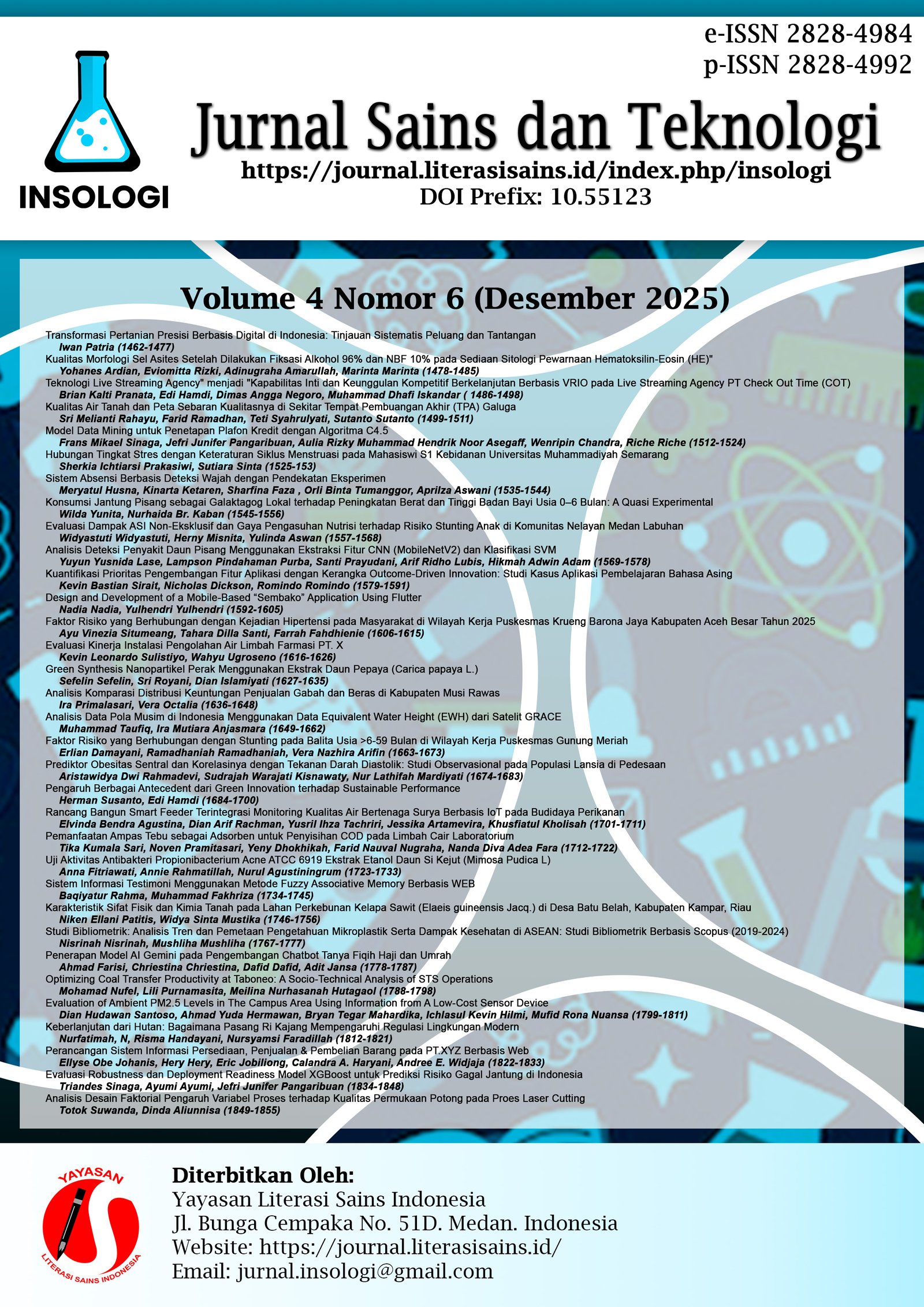
Evaluasi Dampak ASI Non-Eksklusif dan Gaya Pengasuhan Nutrisi terhadap Risiko Stunting Anak di Komunitas Nelayan Medan Labuhan
DOI:
https://doi.org/10.55123/insologi.v4i6.6712Keywords:
Breastfeeding, Nutrition, Stunting, Fishing Community, CoastalAbstract
Stunting is a serious public health issue in Indonesia, with long-term impacts on children’s physical and cognitive development. Fishing communities often face challenges in accessing adequate nutritional information and resources, making it crucial to examine the contributing factors to stunting in these environments. The high prevalence of stunting in coastal areas of Medan, including Medan Labuhan, underscores the urgency of this study. Factors such as low parental education, limited nutritional knowledge, and poor economic conditions contribute significantly to the high incidence of stunting. In addition, non-exclusive breastfeeding practices and suboptimal nutritional parenting styles serve as major risk factors affecting child growth. This study aims to evaluate the impact of non-exclusive breastfeeding and nutritional parenting styles on the risk of stunting among children under five in the fishing community of Medan Labuhan. A quantitative approach with a cross-sectional design was employed, involving 100 respondents selected purposively from Kampung Nelayan Indah, Medan Labuhan. Data were collected through structured questionnaires and anthropometric measurements of children aged 24–59 months. The data were analyzed using chi-square and logistic regression tests. The results indicated that most variables—such as exclusive breastfeeding, breastfeeding frequency, age of complementary feeding introduction, caregiver, number of food types, and daily meal frequency—were not significantly associated with children’s nutritional status (p > 0.05). However, food refusal behavior (≥ 3 times/day) showed a significant association (p < 0.05), indicating that children who frequently refused food were more likely to experience poor nutritional status.
Downloads
References
Ahmad, M., Sechi, C., & Vismara, L. (2024). Advanced maternal age: A scoping review about the psychological impact on mothers, infants, and their relationship. Behavioral Sciences, 14(3), 147. https://doi.org/10.3390/bs14030147
Andrade, J., & Gil, J. (2023). Maternal employment and child malnutrition in Ecuador. International Journal of Environmental Research and Public Health, 20(13), 6253. https://doi.org/10.3390/ijerph20136253
Andriani, H., Rachmadani, S. D., Natasha, V., & Saptari, A. (2022). Continuum of care in maternal, newborn and child health in Indonesia: Evidence from the Indonesia Demographic and Health Survey. Journal of Public Health Research, 11(4), 22799036221127619. https://doi.org/10.1177/22799036221127619
Badan Pusat Statistik (BPS). (2022). Profile of mother and child health 2022. Jakarta: BPS.
Centers for Disease Control and Prevention (CDC)/National Center for Health Statistics (NCHS). (2023). Maternal mortality rates in the United States, 2021.
De Onis, M., Blössner, M., & Borghi, E. (2012). Prevalence and trends of stunting among pre-school children, 1990–2020. Public Health Nutrition, 15(1), 142–148. https://pubmed.ncbi.nlm.nih.gov/21752311/
Dewey, K. G., & Begum, K. (2011). Long‐term consequences of stunting in early life. Maternal & Child Nutrition, 7(Suppl 3), 5. https://www.ncbi.nlm.nih.gov/pmc/articles/PMC6860846/
Grossman, M. (2022). The demand for health turns 50: Reflections. Health Economics, 31(9), 1807–1822. https://doi.org/10.1002/hec.4563
Hadi, H., Fatimatasari, F., Irwanti, W., Kusuma, C., Alfiana, R. D., Asshiddiqi, M. I. N., Nugroho, S., Lewis, E. C., & Gittelsohn, J. (2021). Exclusive breastfeeding protects young children from stunting in a low-income population: A study from Eastern Indonesia. Nutrients, 13(12), 4264. https://doi.org/10.3390/nu13124264
Health Economics Lecture Notes. (2023). Demand for health: The Grossman model.
Helmyati, S. (2020). Stunting: Permasalahan dan penanganannya. Gadjah Mada University Press.
Jum, J., Fauziah, H., & Gama, A. W. (2022). The relationship of exclusive breastfeeding with nutritional status of infants aged 6–12 months in the working area of Paccerakkang Puskesmas. Alami Journal (Alauddin Islamic Medicine), 6(1), 12–20. https://doi.org/10.24252/alami.v6i1.27053
Lestari, K. S. D., Artawan, I. W. G., Putra, E., Karmaya, M., & Magister, S. (2015). Paparan asap rokok pada ibu hamil di rumah tangga terhadap risiko peningkatan kejadian bayi berat lahir rendah di Kabupaten Gianyar. Public Health and Preventive Medicine Archive, 3(1).
Liang, S., Chen, Z., Tang, W., Andarini, E., Kou, L., Li, Y., & Cai, W. (2024). Prevalence and predictors of help-seeking behavior among post-partum women with urinary incontinence in China and Indonesia: A cross-sectional survey based on Andersen Help-Seeking Model. Midwifery, 128, 103885. https://doi.org/10.1016/j.midw.2023.103885
Mardani, R. A. D., Wu, W. R., Nhi, V. T., & Huang, H. C. (2022). Association of breastfeeding with undernutrition among children under 5 years of age in developing countries: A systematic review and meta-analysis. Journal of Nursing Scholarship, 54(6), 692–703. https://doi.org/10.1111/jnu.12799
Maria, T. M., Susaldi, Agustina, N., Masturoh, A., Rahmawati, & Aurima, J. (2021). Faktor-faktor yang berhubungan dengan kejadian stunting pada balita di Indonesia. Open Access Jakarta Journal of Health Sciences, 1(2). http://jakartajournals.net/index.php/oajjhs/article/view/23/6
Melaku, A. B., Qaim, M., & Debela, B. L. (2024). Maternal employment in high-value agriculture and child nutrition: Evidence from the Ethiopian cut-flower industry. Food Policy, 128, 102732. https://doi.org/10.1016/j.foodpol.2024.102732
Mutaqin, Z. Z. (2022). Stunting pada anak. Media Sains Indonesia.
Nurokhmah, S., Middleton, L., & Hendarto, A. (2022). Prevalence and predictors of complementary feeding practices among children aged 6–23 months in Indonesia. Journal of Preventive Medicine and Public Health, 55(6), 549–558.
Phalkey, R. K., Aranda-Jan, C., Marx, S., Höfle, B., & Sauerborn, R. (2015). Systematic review of current efforts to quantify the impacts of climate change on undernutrition. Proceedings of the National Academy of Sciences of the United States of America, 112(33), E4522–E4529. https://www.ncbi.nlm.nih.gov/pmc/articles/PMC4547305/
Prasetyo, Y. B., Permatasari, P., & Susanti, H. D. (2023). The effect of mothers’ nutritional education and knowledge on children’s nutritional status: A systematic review. International Journal of Child Education Policy, 17(11). https://doi.org/10.1186/s40723-023-00114-7
Purwanti, M., Maryam Hasibuan, S., & Riska Mela Putri, S. (2025). Factors Related To The Incidence Of Hyperemesis Gravidarum In The Coastal Area Of Kampung Nelayan Belawan. International Journal of Health, Education & Social (IJHES), 8(3), 103-112.
Rahmawati, T., & Hsieh, H. M. (2024). Appraisal of universal health insurance and maternal health services utilization: Pre- and post-context of the Jaminan Kesehatan Nasional implementation in Indonesia. Frontiers in Public Health, 12, 1301421. https://doi.org/10.3389/fpubh.2024.1301421
Rezaeizadeh, G., Mansournia, M. A., Keshtkar, A., Farahani, Z., Zarepour, F., Sharafkhah, M., Kelishadi, R., & Poustchi, H. (2024). Maternal education and its influence on child growth and nutritional status during the first two years of life: A systematic review and meta-analysis. EClinicalMedicine, 71, 102574. https://doi.org/10.1016/j.eclinm.2024.102574
Ruswati, R., Wulandari Leksono, A., Kartika Prameswary, D., Sekar Pembajeng, G., Felix, J., Shafa Ainan Dini, M., et al. (2021). Risiko penyebab kejadian stunting pada anak. Jurnal Pengabdian Kesehatan Masyarakat, 1(2), 279–284. https://journal.fkm.ui.ac.id/pengmas/article/view/5747
Saefullah, M., & El Syam, R. S. (2022). Asistensi penanganan dan pencegahan stunting di Desa Damarkasiyan Kecamatan Kertek Kabupaten Wonosobo. Nusantara Journal of Community Service, 2(2), 43–50.
Tari, P. I., Rahardjo, S. S., & Setiyadi, N. A. (2023). Meta-analysis: Effects of exclusive breastfeeding, antenatal care visit, and maternal education on stunting in toddlers. Journal of Maternal and Child Health.
Temomona, R. G., & Yuliati, L. (2023). Practice of exclusive breastfeeding and nutritional status of infants aged 6 months. Jurnal Ilmu Kesehatan Masyarakat Berkala (JIKeMB), 5(1).
Uauy, R., Kain, J., & Corvalan, C. (2011). How can the Developmental Origins of Health and Disease (DOHaD) hypothesis contribute to improving health in developing countries? American Journal of Clinical Nutrition, 94(6 Suppl), 1759S–1764S. https://www.ncbi.nlm.nih.gov/pmc/articles/PMC3808270/
UNICEF & World Health Organization. (2025, August 1). Breastfeeding in Indonesia on the rise, but mothers need more support.
UNICEF. (2014). Malnutrition in children. https://data.unicef.org/topic/nutrition/malnutrition/
Victora, C. G., Adair, L., Fall, C., Hallal, P. C., Martorell, R., Richter, L., et al. (2008). Maternal and child undernutrition: Consequences for adult health and human capital. The Lancet, 371(9609), 340. https://www.ncbi.nlm.nih.gov/pmc/articles/PMC2258311/
World Health Organization. (2013). Childhood stunting: Challenges and opportunities. World Health Organization.
World Health Organization. (2023). Operational framework for monitoring social determinants of health equity.
World Health Organization. (2025). Social determinants of health – Fact sheet (updated).
World Health Organization. (2025). World report on social determinants of health equity.
Wulandari, S. D., Iajuna, L., & Kartinazahri, K. (2024). The relationship between exclusive breastfeeding history and the incidence of stunting in children aged 24–59 months in Kuta Baro District, Aceh Besar Regency. International Journal of Health and Medical Research, 3(6).
Downloads
Published
How to Cite
Issue
Section
License
Copyright (c) 2025 Widyastuti Widyastuti, Herny Misnita, Yulinda Aswan

This work is licensed under a Creative Commons Attribution 4.0 International License.
Hak cipta pada setiap artikel adalah milik penulis.
Penulis mengakui bahwa INSOLOGI (Jurnal Sains dan Teknologi) sebagai publisher yang mempublikasikan pertama kali dengan lisensi Creative Commons Attribution 4.0 International License.
Penulis dapat memasukan tulisan secara terpisah, mengatur distribusi non-ekskulif dari naskah yang telah terbit di jurnal ini kedalam versi yang lain, seperti: dikirim ke respository institusi penulis, publikasi kedalam buku, dan lain-lain. Dengan mengakui bahwa naskah telah terbit pertama kali pada INSOLOGI (Jurnal Sains dan Teknologi).