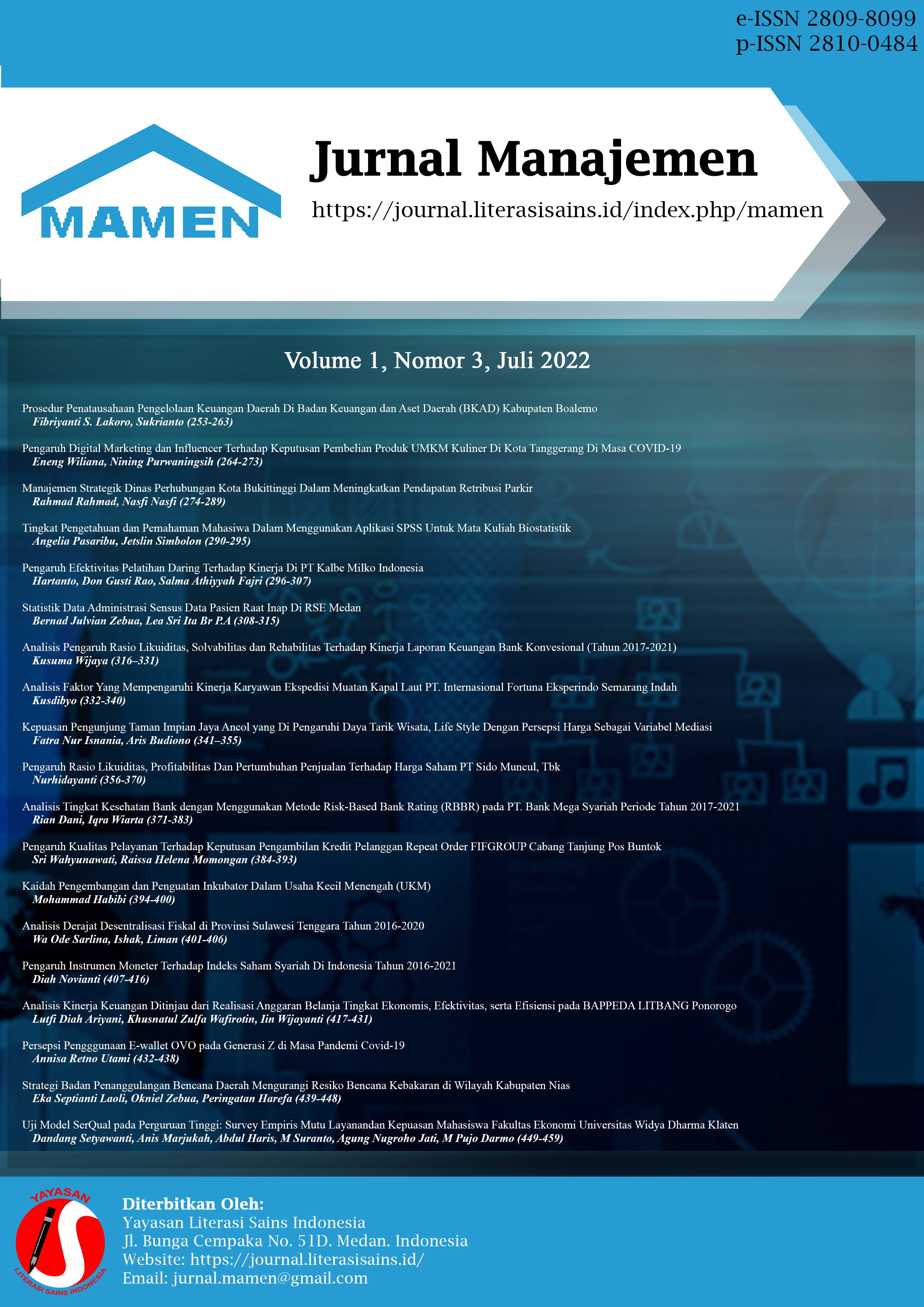
Pengaruh Instrumen Moneter Terhadap Indeks Saham Syariah Di Indonesia Tahun 2016-2021
DOI:
https://doi.org/10.55123/mamen.v1i3.721Keywords:
SBIS, Inflation, Money Supply (JUB), ISSIAbstract
This study aims to examine the effect of monetary instruments, such as SBIS, Inflation, and Money Supply (JUB) on the growth of the Indonesian Sharia Stock Indeks (ISSI) in 2016-2022. This study uses multiple linear regression analysis using SPSS 26 to test the research hypothesis. The data used in this study are monthly data from SBIS yield data, inflation data, the Money Supply (JUB), as well as the ISSI monthly closing point index from January 2016 to December 2021.The results of this study indicate that partially there is an influence between SBIS and T test obtained a significance value of 0.001 < 0.05, , there is no partial effect between inflation based on the T test obtained a significance value of 0.082 > 0.05, and there is an influence between the Money Supply (JUB) based on the T test obtained a significance value of 0.000 < 0 .05 to the growth of the Indonesian Islamic stock index (ISSI) in 2016-2021. Simultaneously SBIS, Inflation and JUB, have an effect and are significant on the growth of ISSI in 2016-2021, with a value (Ftest 38.318 > Ftable 2.51) and a significance (0.000 <0.05).
Downloads
References
Aisyah, S. (2015). Analisis Dampak Ekonomi Makro terhadap ISSI. Conference in Business, Accounting, and Management (CBAM), 409.
Huda, N. (2014). Investasi Pada Pasar Modal Syariah. Prenada Kencana.
Ifham, A. (2015). Ini Bank Syariah. Gramedia Pustaka.
Nanga, M. (2005). Makroekonomi. Grafindo Persada.
Nasarudin, I. M., & Surya, I. (2014). Aspek Hukum Pasar Modal Indonesia. Sinar Grafika.
Novianti, D. (2022). Contagion Effect Covid-19 Terhadap Pasar Modal Syariah Di Kawasan Asia Pasifik. ASY SYAR’IYYAH: JURNAL ILMU SYARI’AH DAN PERBANKAN ISLAM, 7(1), 84–103. https://doi.org/10.32923/ASY.V7I1.2496
Nurhayati, S., & Wasilah. (2018). Akuntansi Syariah di Indonesia. Salemba Empat.
Rahardja, P., & Manurung, M. (2008). Teori Ekonomi Makro. LP FEUI.
Reksoprayitno, S. (2002). Ekonomi Makro Analisis IS-LM & Permintaan Penawaran Agregatif. BPFE.
Samsul, M. (2006). Manajemen Portofolio dan Pasar Modal. Erlangga.
Soemitra, A. (2009). Bank & Lembaga Keuangan. Kencana.
Sugiyono, P. D. (2017). Metode Penelitian Bisnis: Pendekatan Kuantitatif, Kualitatif, Kombinasi, dan R&D. In Penerbit CV. Alfabeta: Bandung.
Sukirno, S. (2010). Makroekonomi Teori Pengantar. Rajawali Pers.
Sunariyah. (2011). Pengetahuan Pasar Modal Pengantar. AMP YKPN.
Suseno, S. (2002). Pengertian Uang dalam Perekonomian. PPSK Bank Indonesia.
Sutedi, A. (2011). Pasar Modal Syariah Sarana Investasi Keuangan Syariah. Sinar Grafika.
XIJI.JK Interactive Stock Chart | Syariah Premier ETF JII Stock - Yahoo Finance. (n.d.). Retrieved June 19, 2022, from https://finance.yahoo.com/chart/XIJI.JK
S. S. Rostiani and T. A. Tuntun A. Sukanta, “Pengaruh Dewan Pengawas Syariah, Profitabilitas Dan Leverage Terhadap Pengungkapan Islamic Social Reporting (ISR),” J. Akunt. Bisnis Dan Ekon., vol. 4, no. 2, pp. 1225–1248, 2018.
Mahdalena, “PENGARUH KOMPOSISI DEWAN KOMISARIS INDEPENDEN, UKURAN DEWAN PENGAWAS SYARIAH, UKURAN KOMITE AUDIT DAN KEPEMILIKAN INSTITUSIONAL TERHADAP PENGUNGKAPAN CORPORATE SOCIAL RESPONSIBILITY BERDASARKAN INDEKS ISLAMIC SOCIAL REPORTING (ISR) PADA BANK UMUM SYARIAH ,” מים והשקייה, vol. 549, pp. 40–42, 2017.
Downloads
Published
How to Cite
Issue
Section
License
Copyright (c) 2022 Diah Novianti

This work is licensed under a Creative Commons Attribution 4.0 International License.
Hak cipta pada setiap artikel adalah milik penulis.
Penulis mengakui bahwa MAMEN (Jurnal Manajemen) sebagai publisher yang mempublikasikan pertama kali dengan lisensi
Creative Commons Attribution 4.0 International License.
Penulis dapat memasukan tulisan secara terpisah, mengatur distribusi non-ekskulif dari naskah yang telah terbit di jurnal ini kedalam versi yang lain, seperti: dikirim ke respository institusi penulis, publikasi kedalam buku, dan lain-lain. Dengan mengakui bahwa naskah telah terbit pertama kali pada MAMEN (Jurnal Manajemen).