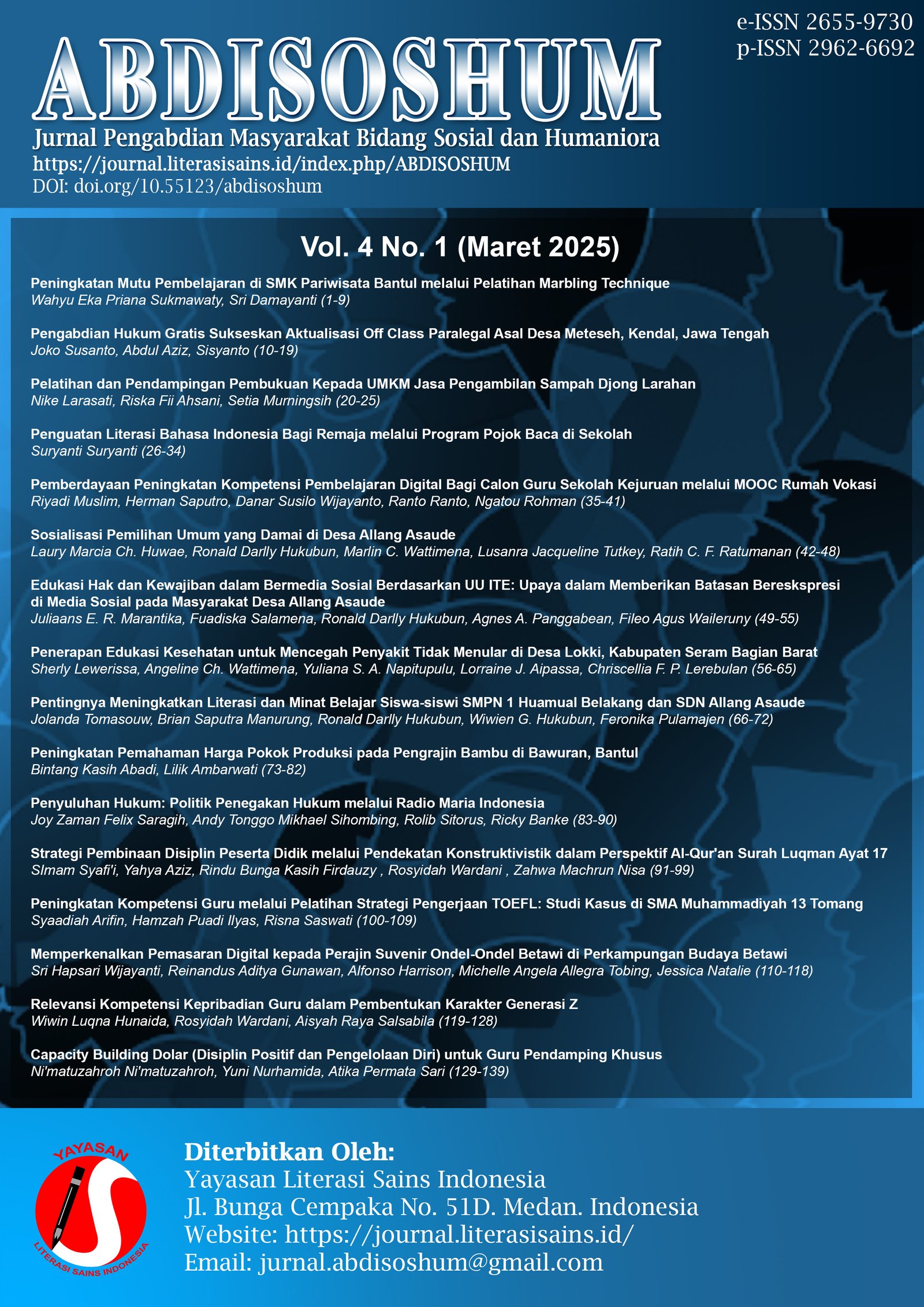
Strategi Pembinaan Disiplin Peserta Didik melalui Pendekatan Konstruktivistik dalam Perspektif Al-Qur'an Surah Luqman Ayat 17
DOI:
https://doi.org/10.55123/abdisoshum.v4i1.4977Keywords:
Constructivistic Approach, Discipline, QS. Luqman Verse 17Abstract
In this era of rapid technological development, promoting student discipline is a major challenge for educators. This research focuses on examining the strategy of promoting student discipline through a constructivist approach from the perspective of QS. This research uses a literature review method with a qualitative descriptive approach. The research data will be taken from the Qur'anic Hadith, various books of Tafsir, articles and relevant journals. The data collected is then analysed in depth in order to draw conclusions. The results show that the constructivist approach is an effective method used to promote student discipline. The strategies used by teachers are role modelling, advice, reward and punishment systems, habituation and special attention to students. In the Islamic perspective, it is also derived from QS. Luqman verse 17 provides a glimpse of disciplining students through the command to pray, amar ma'ruf nahi mungkar, and always be patient in the face of trials. Thus, the application of the constructivist approach in promoting student discipline from the perspective of QS. Luqman verse 17 is very relevant and effective. Thus, this research has been conducted to add insight to the literature for educators, educational institutions and other educational institutions.
References
Anshori, Yoyo Zakaria. 2020. “Penguatan Karakter Disiplin Siswa Melalui Peranan Guru Di Sekolah Dasar.” Jurnal Elementaria Edukasia 3(1): 928–33.
Al Ayyubi, Ibnu Imam et al. 2024. “Konsep Pendidikan Anak Usia Dini Perspektif Q.S Luqman Ayat 13-19.” Al-Fahmu: Jurnal Ilmu Al-Qur’an dan Tafsir 3(1): 31–41.
Battuta, Universitas, Nur Wahyuni, and Wanda Mulcia Sari. 2023. “Strategi Pengelolaan Kelas Untuk Meningkatkan Kedisiplinan Siswa Di Sekolah Dasar.” 8(1): 49–57.
Briliantara, Tanzillal Ula, and Hakimuddin Salim. 2024. “Peran Guru Pendidikan Agama Islam Dalam Mendidik Karakter Disiplin Peserta Didik Di SMP Negeri 3 Purwodadi.” Jurnal Kependidikan 13(2): 1936–44. https://jurnaldidaktika.org.
Celine, Devi Rofidah, and Ahmad Yusam Thobroni. 2024. “NILAI-NILAI PENDIDIKAN UNGGUL PERSPEKTIF.” VII(2): 106–33.
Fu’adah, Euis Nur, and Yumidiana Tya Nugraheni. 2020. “Perintah Shalat Pada Anak Perspektif Surat Luqman Ayat 17 (Telaah Pendekatan Normatif Dan Filologi).” Jurnal Kependidikan 8(1): 1–9.
Harefa, Meidarwati, Jesslyn Elisandra Harefa, Amstrong Harefa, and Hendrikus O N Harefa. 2023. “Kajian Analisis Pendekatan Teori Konstruktivisme Dalam Proses Belajar Mengajar.” Educativo: Jurnal Pendidikan 2(1): 289–97.
Hidayat, Muhammad Fajar, Chelse V. Muyu, and Romi Mesra. 2023. “Peran Guru Dalam Meningkatkan Disiplin Siswa Di SMA Negeri 1 Motoling.” Jurnal Integrasi dan Harmoni Inovatif Ilmu-Ilmu Sosial (JIHI3S) 3(5): 525–32.
Kasus, Studi et al. 2024. “Menggali Nilai-Nilai Karakter Melalui Pendidikan Al-Quran :” 13(2): 306–27.
Manshur, Ahmad. 2019. “Strategi Pengembangan Kedisiplinan Siswa.” Al Ulya : Jurnal Pendidikan Islam 4(1): 16–28.
Muhammad Fariq, Wan, Amrina Rosyada, and Ulfa Rahma Dhini. 2023. “Peran Orang Tua Dalam Membentuk Karakter Anak Berdasarkan Surah Luqman Ayat 17-19; Perspektif Tafsir Al-Misbah.” Al-Mau’izhoh 5(2): 377–94.
Nurhayati, S. 2021. “Penggunaan Teknologi Informasi Dalam Dakwah Di Pedesaan.” Teknologi Dakwah 4(2).
Putra, Arizal Eka et al. 2024. “Peserta Didik Kelas Viii Oleh Guru.” 7: 7465–70.
Rahmah, Fadilah Khoirur. 2017. “Strategi Pembinaan Sikap Disiplin Pada Peserta Didik Kelas Viii Di Mts. Al-Hurriyah Kecamatan Panei Kabupaten Simalungun.” : 25.
Rianti, Erikka, and Dea Mustika. 2023. “Peran Guru Dalam Pembinaan Karakter Disiplin Peserta Didik.” Murhum : Jurnal Pendidikan Anak Usia Dini 4(2): 360–73.
Sundari, Sundari, and Eva Dina Chairunisa. 2018. “Pengaruh Model Pembelajaran Generatif (Generative Learning) Terhadap Hasil Belajar Siswa Pada Mata Pelajaran Ips Terpadu (Sejarah) Kelas Vii Di Smp Negeri 15 Palembang.” Kalpataru: Jurnal Sejarah dan Pembelajaran Sejarah 4(1): 1–9.
Supardan, H. Dadang. 2016. “Teori Dan Pratik Pendekatan Dalam Pembelajaran.” Jurnal Edunomic 4 No.1(1): 1–15.
A. De Kock, P. S. (2005). New Learning and Choices of Secondary School TEachers When Arranging Learning Envirornments. Teaching and Teacher Education.
A. Tishana, D. A. (2023). Filsafat Konstruktivisme dalam Mengembangkan Calon Pendidik pada Implementasi Merdeka Belajar di Sekolah Kejuruan. Journal on Education , 1855-1867.
Antika, T. L. (2023). Upaya Meningkatkan Hasil Pembelajaran Siswa dalam Pembelajaran Bahasa Indonesia Menggunakan Model Pembelajaran Konstruktivisme. Jurnal Penelitian Bahasa Indonesia dan Humaniora, 17-35.
Darwin, W. (2020). Efektivitas Pengembangan Modul Berbasis Konstruktivisme Pada Mata Pelajaran Sistem Komputer Bagi Siswa TKJ Tingkat SMK. Jurnal Edutech Undiksha, 147-155.
Glasersfeld, E. v. (1987). The Consteuction of Knowledge: Contributions to Conceptual Semantics. CA: Intersystems Publications.
Harefa, A. (2022). Pengaruh Globalisasi Terhadap Perilaku Sosial Siswa. Educativo: Jurnal Pendidikan, 271-277.
M. S. Zulela, Y. E. (2017). Keterampilan Menulis Narasi Melalui Pendekatan Konstruktivisme di Sekolah Dasar. Jurnal Pendidikan Dasar 8, 112-123.
Nurhidayati, E. (2017). Indonesian Journal of Educational Counseling, 1-14.
Nurhidayati, E. (2017). Pedagogi Konstruktivisme dalam Praksis Pendidikan Indonesia. Indonesian Journal of Educational Counseling, 1-14.
Palincsar, A. S. (1998). "Keeping the Metaphor of Scaffolding Fresh – A Response to C. Addison Stone‘s 'The Metaphor of Scaffolding: Its Utility for the Field of Learning Disabilities". Journal of Learning Disabilities 31 , 370-373.
R. Bruning, G. S. (2004). Cognitive Psychology and Instruction. NJ: Prentice Hall.
Downloads
Published
How to Cite
Issue
Section
License
Copyright (c) 2025 ABDISOSHUM: Jurnal Pengabdian Masyarakat Bidang Sosial dan Humaniora

This work is licensed under a Creative Commons Attribution-ShareAlike 4.0 International License.