
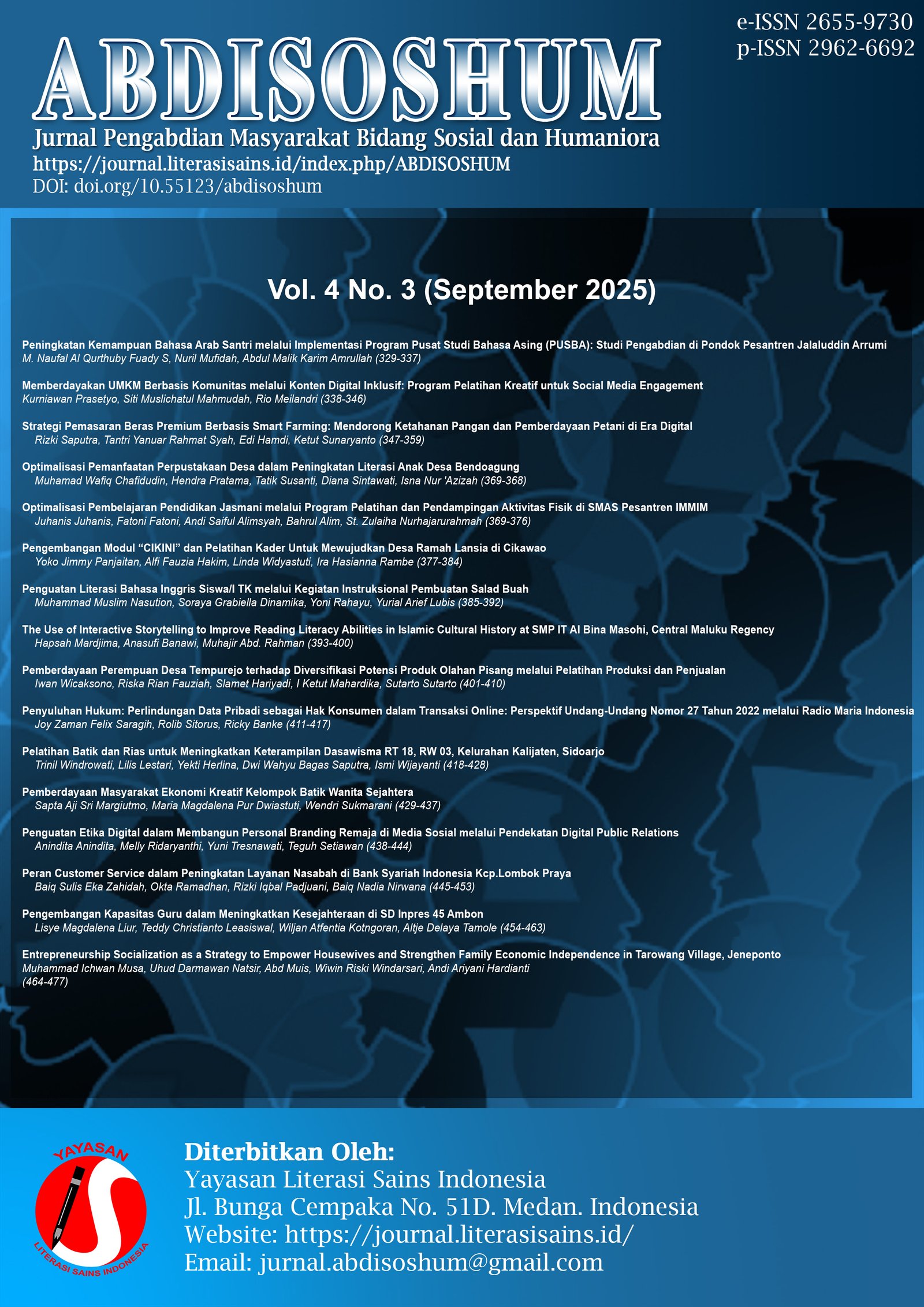
Pemberdayaan Masyarakat Ekonomi Kreatif Kelompok Batik Wanita Sejahtera
DOI:
https://doi.org/10.55123/abdisoshum.v4i3.6464Keywords:
Community Empowerment, Batik Group, Equipment, Training, InnovationAbstract
The Special Region of Yogyakarta is one of Indonesia's leading tourist destinations, encouraging the growth of various creative economic sectors, including the souvenir and local craft industries. One community initiative that emerged from this opportunity is the Wanita Sejahtera Batik Group in Muja Muju, Umbulharjo, Yogyakarta. Established in 2023, the group aims to achieve economic empowerment for housewives through traditional batik production, including hand-drawn and stamped batik. However, the group faces several challenges, especially limited access to modern equipment, design innovation, and appropriate technology—factors that hinder the competitiveness of their products in both local and global markets. To address these challenges, capacity building is essential through the implementation of appropriate technology, such as replacing kerosene stoves with electric stoves and using electric canting tools, enabling more efficient and higher-quality production. Additionally, creative design training and product diversification with a focus on sustainability are crucial strategies. One notable innovation is the use of recycled cardboard waste as batik stamping tools, which not only supports environmental sustainability but also adds aesthetic and creative value to the products as part of eco-friendly goods. This innovation strengthens the group's position within the creative economy sector and aligns with market demands that increasingly prioritize sustainable and high-quality products. Through the integration of technological innovation, skill development, and eco-conscious approaches, the Wanita Sejahtera Batik Group has the potential to transform into a highly competitive business player, both nationally and internationally.
References
Balakrishnan, N. (2021). Rencana Induk Riset Nasional Tahun 2017-2045. In Handbook of the Logistic Distribution (Vol. 2045). https://doi.org/10.1201/9781482277098-12
Cahyani, N., & Effendi, M. (2022). Pemanfaatan Digital Marketing UMKM Berbasis Kearifan Lokal Batik Bogor Melalui Media Sosial. Jurnal Abdimas Dedikasi Kesatuan, 3(2), 17–22. https://doi.org/10.37641/jadkes.v3i2.1644
Kementerian Koperasi dan UKM. (2021). Pemberdayaan UMKM dalam Mendorong Ekonomi Nasional. Kemenkop UKM.
Lambang, P. D. (2023). Mengenal 17 Tujuan SDGs Pembangunan Berkelanjutan Beserta Penjelasannya. Kompas.Com. https://lestari.kompas.com/read/2023/05/02/080000486/mengenal-17-tujuan-sdgs-pembangunan-berkelanjutan-beserta-penjelasannya?page=all
Pemerintah Kota Yogyakarta. (2022). Gandeng Gendong Upaya Nyata Pengentasan Kemiskinan di Kota Yogya. Portal Berita Pemerintah Kota Yogyakarta. https://warta.jogjakota.go.id/detail/index/20144
Peraturan Metri Kesehatan. (2021). Standar Kegiatan Usaha dan Produk pada Penyelenggaraan Perizinan Berusaha Berbasis Risiko di sektor kesehatan (Nomor 14 Tahun 2021).
Peraturan Pemerintah RI. (2021). Penyelenggaraan Perizinan Berusaha Berbasis Risiko (Nomor 5 Tahun 2021).
Presiden Asta Cita Presiden dan Wakil. (2024). 8 Misi Asta Cita, Bersama Indonesia Maju Menuju Indonesia Emas 2045. Kompasiana.Com. https://www.kompasiana.com/rupbasanjakbar/671f1758c925c477f253e4a6/8-misi-asta-cita-bersama-indonesia-maju-menuju-indonesia-emas-2045
Putri, R. A. (2022). Pemanfaatan Limbah Kardus sebagai Media Alternatif Batik Cap. Jurnal Seni Dan Desain, 8(1), 23–30.
Rokhmania, N., Awan, S. H., Lutfi, L., & ... (2023). Digital Marketing Bagi UMKM: Studi Kasus Batik Era Krisna. Jurnal Kemitraan …, 3(1), 25–39. https://doi.org/https://doi.org/10.14414/kedaymas.v3i1.3520
Sartika, D. A. (2020). Strategi Diversifikasi Produk Batik untuk Meningkatkan Daya Saing di Pasar Global. Prosiding Seminar Nasional Ekonomi Dan Bisnis, 2(1), 112–119.
Smartlegal.id. (2022). Kini Mengurus Perizinan Pangan Industri Rumah Tangga Bisa Melalui OSS. https://smartlegal.id/perizinan/2022/03/17/kini-mengurus-perizinan-pangan-industri-rumah-tangga-bisa-melalui-oss/#:~:text=Kini Mengurus Perizinan Pangan Industri Rumah Tangga Bisa Melalui OSS
UN Environment Programme. (2021). Sustainable Consumption and Production: A Handbook for Policy Makers. UNEP.
Undang-Undang Republik indonesia. (2020). Cipta Kerja (Nomor 11 Tahun 2020).
Widodo, A., & Pramudito, H. (2020). Penerapan Teknologi Tepat Guna dalam Proses Produksi Batik. Jurnal Teknologi Terapan, 5(2), 45–51.
Winarni, D., Fakhruddin, I., & Kusbandiyah, A. (2025). Pemasaran dan Keuangan Digital untuk Tingkatkan Pendapatan Usaha Batik di Desa Srowot. SAFARI: Jurnal Pengabdian Masyarakat Indonesia, 5(3), 209–218. https://doi.org/https://doi.org/10.56910/safari.v5i3.2734
Yuliani, L. (2019). Eco-Batik: Batik Ramah Lingkungan sebagai Strategi Inovasi Produk Kreatif. Jurnal Ekonomi Kreatif Dan Inovasi, 3(2), 67–75.
Yuniarto, T. (2025). Menilik Situasi Ekonomi-Sosial Indonesia di Awal 2025. Kompas Pedia. https://kompaspedia.kompas.id/baca/paparan-topik/menilik-situasi-ekonomi-sosial-indonesia-di-awal-2025?utm_source=chatgpt.com
Downloads
Published
How to Cite
Issue
Section
License
Copyright (c) 2025 ABDISOSHUM: Jurnal Pengabdian Masyarakat Bidang Sosial dan Humaniora

This work is licensed under a Creative Commons Attribution-ShareAlike 4.0 International License.












