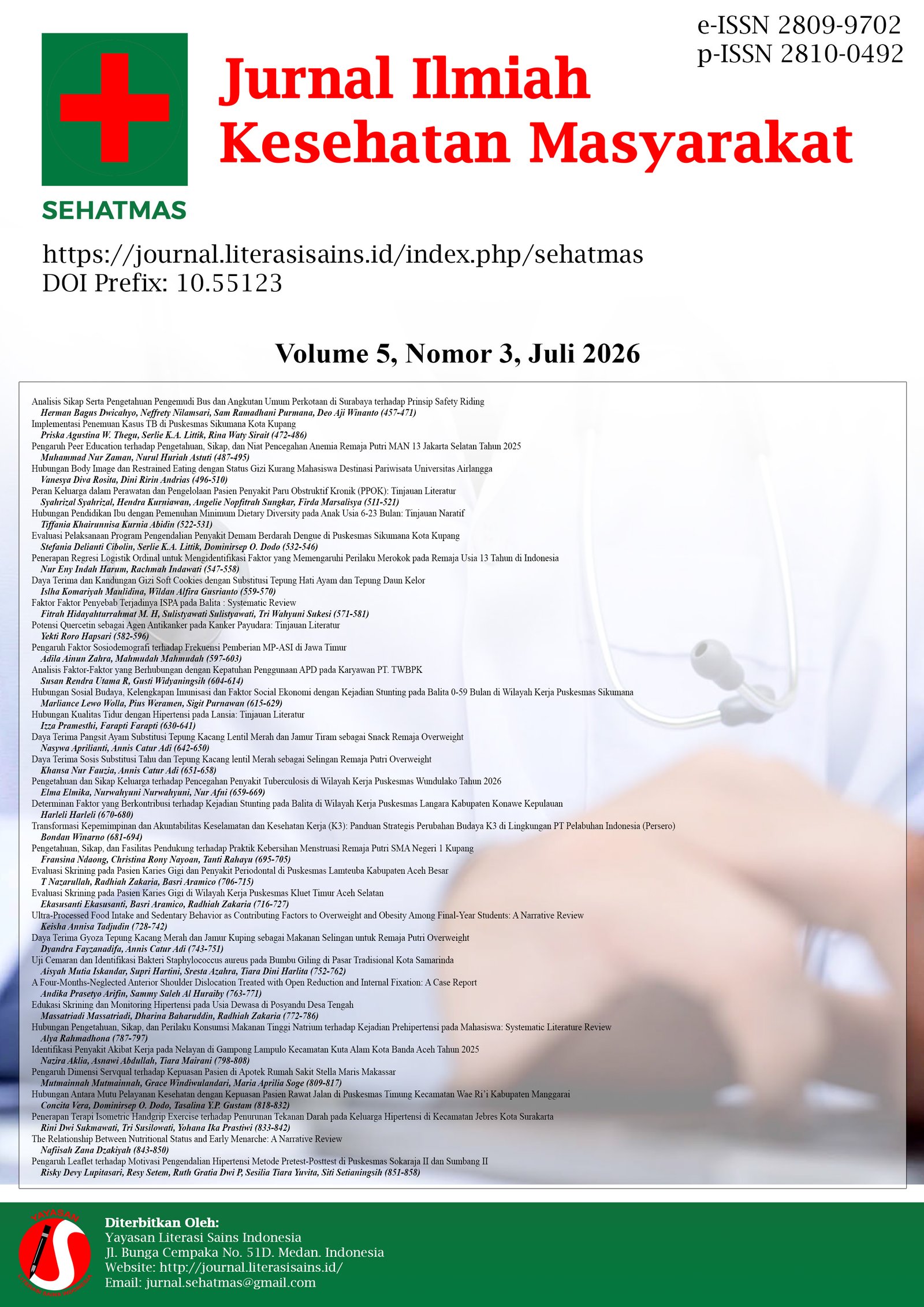
Determinan Faktor yang Berkontribusi terhadap Kejadian Stunting pada Balita di Wilayah Kerja Puskesmas Langara Kabupaten Konawe Kepulauan
DOI:
https://doi.org/10.55123/sehatmas.v5i3.8186Keywords:
Children Under Five, Stunting, Complementary Feeding, Family IncomeAbstract
Stunting is a chronic nutritional problem among children under five. The assessment of stunting status is conducted using the height-for-age (HFA) index based on z-scores, where a value of < −2 standard deviations indicates stunting. This study aimed to identify determinant factors contributing to stunting among children aged 12–59 months in the working area of Langara Public Health Center. This study employed a quantitative approach with an analytical cross-sectional design. The sample consisted of 100 children under five selected using simple random sampling. The inclusion criteria were children aged 12–59 months at the time of the study. Data were collected through observation and interviews using questionnaires on respondent characteristics, complementary feeding (MP-ASI) history, and family income. Data analysis was conducted bivariately using the Chi-Square test with a significance level of α = 0.05. The bivariate analysis results showed a significant association between complementary feeding history (p = 0.003), while family income showed no significant association (p = 0.223) with the incidence of stunting among children aged 12–59 months in the working area of Langara Public Health Center.
Downloads
References
Agustia, V., & Rosyada, A. (2023). Hubungan Air, Hygiene, dan Sanitasi terhadap Kejadian Stunting. PREPOTIF: Jurnal Kesehatan Masyarakat, 7(3), 16946– 16956. https://doi.org/10.31004/prepotif.v7i3.22508
Akombi BJ, Agho KE, Hall JJ, et al. Complementary feeding practices and childhood growth outcomes: evidence from low- and middle-income countries. Nutrients. 2023;15(13):3041. doi: 10.3390/nu15133041
Badan Perencanaan Pembangunan Nasional Republik Indonesia (Bappenas). (2020). Strategi Nasional Percepatan Pencegahan Stunting 2018–2024. Jakarta: Bappenas.
Beal, T., Tumilowicz, A., Sutrisna, A., Izwardy, D., & Neufeld, L. M. (2018). A review of child stunting determinants in Indonesia. Maternal & Child Nutrition, 14(4), e12617. https://doi.org/10.1111/mcn.12617
Badan Perencanaan Pembangunan Nasional Republik Indonesia (Bappenas). (2020). Strategi Nasional Percepatan Pencegahan Stunting 2018–2024. Jakarta: Bappenas.
Dadras, O., Suwanbamrung, C., Jafari, M., & Stanikzai, M. H. (2023). Determinants of stunting among children under five in Pakistan. Nutrients, 15(15), 3480. https://doi.org/10.3390/nu15153480
Dos Santos Leal, K., Pinto da Costa, M., & Vilela, S. (2024). Socioeconomic and household framework influences in school-aged children's eating habits: Understanding parental roles. Appetite, 182, 107605. https://doi.org/10.1016/j.appet.2024.107605
Fauziah, S. S., Hadiyanto, H., Hamidah, E., & Basri, B. (2024). Hubungan Status Ekonomi Keluarga dan Pengetahuan Keluarga dengan Kejadian Stunting. Journal of Public Health Innovation, 5(1), 140–147. https://doi.org/10.34305/jphi.v5i01.1449
Fitriani, P., & Kamidah, N. (2024). Hubungan pemberian MP-ASI dengan kejadian stunting pada balita di wilayah kerja Puskesmas Wanaraja Kabupaten Garut tahun 2023–2024. Jurnal Gizi dan Kesehatan Masyarakat Indonesia, 7(1), 45–53. https://doi.org/10.12345/jgki.v7i1.6789
Hossain, M. M., Hasan, M. M., Islam, M. S., & Rahman, M. M. (2022). Child feeding practices and stunting among children aged 6–59 months: Evidence from developing countries. BMC Public Health, 22, 2035. https://doi.org/10.1186/s12889-022-14433-8
Kementerian Kesehatan Republik Indonesia. (2022). Buku Saku Hasil Survei Status Gizi Indonesia (SSGI) Tahun 2021. Jakarta: Kemenkes RI.
Louis, S. L., Tappis, H., & Sellen, D. (2022). Complementary feeding practices and child growth: Evidence and implications. Nutrients, 14(4), 873. https://doi.org/10.3390/nu14040873
Natara, A. I., Siswati, T., & Sitasari, A. (2023). Asupan zat gizi makro dan mikro dengan kejadian stunting pada balita usia 12–59 bulan di wilayah kerja Puskesmas Radamata. Journal of Nutrition College, 12(3), 192–197. https://doi.org/10.14710/jnc.v12i3.34499
Ni’mah, S. M., & Sukendra, D. M. (2023). Hubungan Antara Pengetahuan , Sikap , Dan Praktik Ibu Dalam Pemberian Kejadian Stunting Di Wilayah Kerja Puskesmas Singgahan Kabupaten. Jurnal Kesehatan Masyarakat, 11(2), 160–167. https://ejournal3.undip.ac.id/index.php/jkm/article/view/37707/29087
Nuradhiani, R. (2020). Pengaruh praktik pemberian makanan pendamping ASI terhadap status gizi balita di daerah perdesaan Indonesia. Jurnal Kesehatan Terapan, 5(3), 221–229. https://doi.org/10.20473/jkt.v5i3.28476
Puskesmas Langara. (2023). Profil Kesehatan Puskesmas Langara Tahun 2023. Konawe Kepulauan: Puskesmas Langara.
Purwana A, Budiono B, Batubara JR, Faizi M. Association of growth velocity with insulin-like growth factor-1 and binding protein-3 levels in children with a vegan diet. J Biomed Transl Res. 2020;6(1):6-10. doi: 10.14710/jbtr.v6i1.5474
Sangadji, N. W., Setyowati, S., Kusumaningtiar, D. A., Shorayasari, S., & Rusdy, M. D. R. (2024). Family-Related Factors Associated with Stunting. Jurnal Kesehatan, 16(1). https://doi.org/10.26630/jk.v16i1.4287
Septiani, R. E., Mulyaningsih, T., & Mulyanto. (2023). The Effect of Macroeconomics and Access to Health Service on Stunting in Indonesia. Health Science Journal of Indonesia, 14(1). https://doi.org/10.22435/hsji.v14i1.6440
UNICEF. (2021). The State of the World’s Children 2021: On My Mind. New York: UNICEF.
UNICEF. (2022). Stopping stunting: Indonesia’s nutrition challenge. UNICEF Indonesia Report. https://www.unicef.org/indonesia
Victora, C. G., Christian, P., Vidaletti, L. P., Gatica-Domínguez, G., Menon, P., & Black, R. E. (2021). Revisiting maternal and child undernutrition in low- income and middle- income countries: variable progress towards an unfinished agenda. The Lancet, 397(10282), 1388–1399. https://doi.org/10.1016/S0140-6736(21)00394-9
Woldesenbet, B., Tolcha, A., & Tsegaye, B. (2023). Water, hygiene and sanitation practices are associated with stunting among children aged 24–59 months in Lemo district, South Ethiopia: A community-based cross-sectional study. BMC Nutrition, 9(1), 17. https://doi.org/10.1186/s40795-023-00677-1
World Health Organization. (2023). WHO guideline for complementary feeding of infants and young children 6–23 months of age. Geneva: WHO. https://doi.org/10.4060/cc8177en
Yunitasari, E., Al Faisal, A. H., Efendi, F., et al. (2022). Factors associated with complementary feeding practices among children aged 6–23 months in Indonesia. BMC Pediatrics, 22(1), 727. DOI: https://doi.org/10.1186/s12887-022-03728-x
Downloads
Published
How to Cite
Issue
Section
License
Copyright (c) 2026 Harleli Harleli

This work is licensed under a Creative Commons Attribution 4.0 International License.
Hak cipta pada setiap artikel adalah milik penulis.
Penulis mengakui bahwa SEHATMAS (Jurnal Ilmiah Kesehatan Masyarakat) sebagai publisher yang mempublikasikan pertama kali dengan lisensi Creative Commons Attribution 4.0 International License.
Penulis dapat memasukan tulisan secara terpisah, mengatur distribusi non-ekskulif dari naskah yang telah terbit di jurnal ini kedalam versi yang lain, seperti: dikirim ke respository institusi penulis, publikasi kedalam buku, dan lain-lain. Dengan mengakui bahwa naskah telah terbit pertama kali pada SEHATMAS (Jurnal Ilmiah Kesehatan Masyarakat).