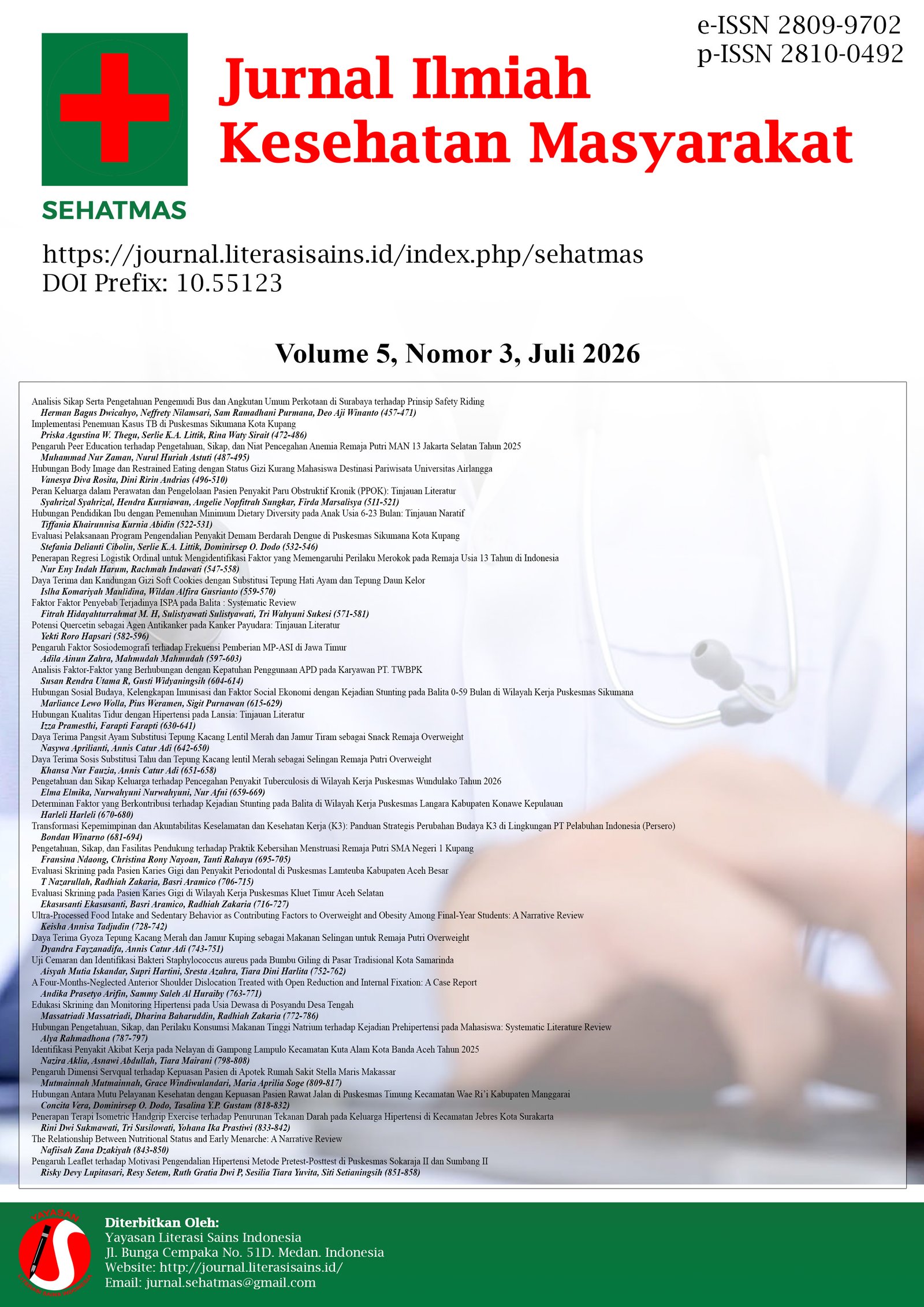
Daya Terima Pangsit Ayam Substitusi Tepung Kacang Lentil Merah dan Jamur Tiram sebagai Snack Remaja Overweight
DOI:
https://doi.org/10.55123/sehatmas.v5i3.8627Keywords:
Chicken Wonton, Red Lentil Flour, Oyster Mushroom, Dietary Fiber, Fat, Overweight AdolescentsAbstract
Overweight in adolescents is a serious nutritional problem with a national prevalence of 32.8% in Indonesia. One contributing factor is the high consumption of snacks with elevated fat content and low dietary fiber. This study aimed to analyze the effect of red lentil flour and oyster mushroom substitution on the hedonik acceptability and nutritional content of chicken wonton as a high-fiber, low-fat snack alternative for overweight adolescents. This study used an experimental design with a Completely Randomized Design (CRD) approach involving three formulas: F0 (kontrol), F3, and F4. Hedonik tests were conducted by 30 semi-trained panelists aged 16–18 years, evaluating taste, color, aroma, and texture. Data were analyzed using the Shapiro-Wilk, Friedman, and Wilcoxon Signed-Rank tests. Results showed that substitution significantly affected taste (p = 0.003), while color, aroma, and texture showed no significant differences. All formulas remained in the "like" category. Laboratory analysis revealed that F4 had the lowest fat content (3.79 g) and highest total dietary fiber (4.92 g) per serving, contributing 4.46% and 13.33% of daily requirements based on the 2019 Nutritional Adequacy Rate (RDA), qualifying for a "fiber source" claim per BPOM Regulation No. 22/2019. Red lentil flour and oyster mushroom substitution effectively increases fiber content and reduces fat in chicken wonton without significantly reducing hedonik acceptability.
Downloads
References
Alya, B., Telisa, I., & Terati. (2023). Uji Daya Terima Nugget Panggang Dengan Substitusi Jamur Tiram, Wortel dan Tepung Jagung Sebagai Produk Snack Sehat Sumber Serat. Jurnal Kesehatan Poltekkes Palembang, 18(1), 28–35.
Andrini, P. (2023). Hubungan Pola Makan Dan Aktivitas Fisik Dengan Kejadian Overweight Pada Remaja. Jurnal Kesehatan Mercusuar, 6(2), 019–027.
Ernawati, F., Pusparini, P., Arifin, A. Y., & Prihatini, M. (2019). Hubungan asupan lemak dengan status gizi anak usia 6 bulan–12 tahun di Indonesia. Penelitian Gizi Dan Makanan, 42(1), 41–47.
Ganesan, K., & Xu, B. (2017). Polyphenol-Rich Lentils and Their Health Promoting Effects. International Journal of Molecular Sciences, 18(11), 2390. https://doi.org/10.3390/ijms18112390
Isnaini, M., Afgani, M. W., Haqqi, A., and Azhari, I. (2025). Teknik Analisis Data Uji Normalitas. J-CEKI: Jurnal Cendekia Ilmiah, 4(2), 1377-1
Kencanaputri, S. A., Ilmi, I. M. B., & Simanungkalit, S. F. (2024). The Effect of Food Diversity, Junk Food, and High Sugar Products on The Incidence of Overnutrition in Adolescent of SMAN 6 Depok. Amerta Nutrition, 8(3), 115–126.
Kementerian Kesehatan RI. 2018. Hasil Riset Kesehatan Dasar (Riskesdas) 2018. Jakarta: Badan Penelitian dan Pengembangan Kesehatan Kementerian RI.
Kurdanti, W., Suryani, I., Syamsiatun, N. H., Siwi, L. P., Adityanti, M. M., Mustikaningsih, D., & Sholihah, K. I. (2015). Faktor-faktor yang mempengaruhi kejadian obesitas pada remaja. Jurnal Gizi Klinik Indonesia, 11(4), 179–190.
Multescu, M., Culetu, A., & Susman, I. E. (2024). Screening of the Nutritional Properties, Bioactive Components, and Antioxidant Properties in Legumes. Foods, 13(22), 3528. https://doi.org/10.3390/foods13223528
Mukhlisa, W. N. I., Rahayu, L. S. & Furqan, M. (2018). Asupan Energi dan Konsumsi Makanan Ringan Berhubungan dengan Kejadian Gizi Lebih Pada Remaja. ARGIPA, 3(2), 59-66.
Moffitt, L., and Thomas, M. S. (2025). Influence of Social Media on Dietary Habits and Nutritional Choices in Adolescents: A Systematic Review of the Evidence. International Journal of Nutrition and Food Sciences, 14(4), 211-225. https://doi.org/10.11648/j.ijnfs.20251404.14
Ni’mah, S. L., & Fauziah, L. F. (2024). Analisis Kandungan Serat pada Snack Bar Substitusi Tepung Bekatul dan Tepung Jamur Tiram Putih. INSOLOGI: Jurnal Sains dan Teknologi, 3(5), 511–519.
Niara, S. I., & Pertiwi, Y. (2022). Pencegahan Obesitas pada Remaja Melalui Intervensi Promosi Kesehatan: Studi Literatur. Jurnal Ilmiah Kesehatan Masyarakat, 14(2), 96–104.
Panadia, Z. F., & Suryaalamsah, I. I. (2023). Pengaruh Penambahan Tepung Tempe dan Tepung Kacang Lentil Terhadap Kadar Protein dan Mutu Organoleptik Mie Basah. Jurnal Gizi Kerja dan Produktivitas, 4(1), 1–11.
Panda, J., et al. (2025). Mushroom: an Emerging Source For Next Generation Meat Analogues. Frontiers in Nutrition, 1–23.
Pratita, A.T.K., Meri, M., and Fathurohman, M. (2021). Analisis kadar serat pati termodifikasi lentil merah dan lentil hitam. Jurnal Kesehatan Bakti Tunas Husada, 21(2), 1–7. https://doi.org/10.36465/jkbth.v21i2.747.
Rahmat, M., Gumilar, M., & Dewi, M. (2023). Efektivitas Pemberian Cookies Tape Ketan Hitam dan Edukasi Gizi Terhadap Penurunan Berat Badan Pada Remaja Gemuk. Media Penelitian dan Pengembangan Kesehatan, 33(4), 255–267.
TKPI. (2020). Tabel Komposisi Pangan Indonesia. Kementerian Kesehatan Republik Indonesia.
USDA. (2023). Food Data Central. United States Department of Agriculture. https://fdc.nal.usda.gov
Zhang, B., et al. (2018). Effects of different processing methods on phenolic profiles and antioxidant activities in lentils (Lens culinaris M.). Food Chemistry, 243, 216–224.
Downloads
Published
How to Cite
Issue
Section
License
Copyright (c) 2026 Nasywa Aprilianti, Annis Catur Adi

This work is licensed under a Creative Commons Attribution 4.0 International License.
Hak cipta pada setiap artikel adalah milik penulis.
Penulis mengakui bahwa SEHATMAS (Jurnal Ilmiah Kesehatan Masyarakat) sebagai publisher yang mempublikasikan pertama kali dengan lisensi Creative Commons Attribution 4.0 International License.
Penulis dapat memasukan tulisan secara terpisah, mengatur distribusi non-ekskulif dari naskah yang telah terbit di jurnal ini kedalam versi yang lain, seperti: dikirim ke respository institusi penulis, publikasi kedalam buku, dan lain-lain. Dengan mengakui bahwa naskah telah terbit pertama kali pada SEHATMAS (Jurnal Ilmiah Kesehatan Masyarakat).