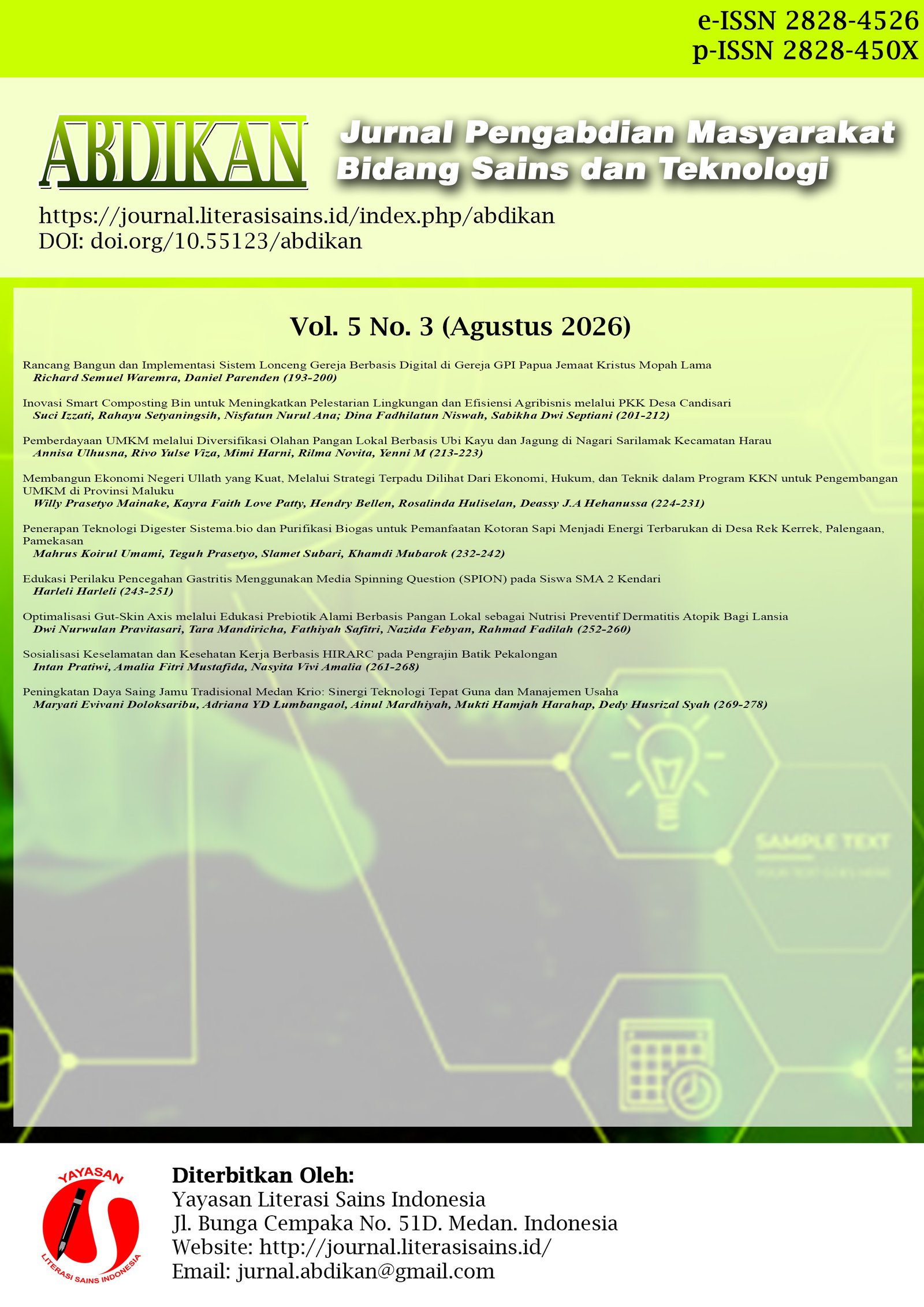
Edukasi Perilaku Pencegahan Gastritis Menggunakan Media Spinning Question (SPION) pada Siswa SMA 2 Kendari
DOI:
https://doi.org/10.55123/abdikan.v5i3.8249Keywords:
Gastritis, Health Education, Spinning Question (SPION)Abstract
Gastritis is an inflammation of the stomach that can cause irritation and damage to the gastric lining, resulting in symptoms such as epigastric pain, nausea, vomiting, and digestive disturbances. This community service activity aimed to improve students’ preventive behaviors regarding gastritis at SMA 2 Kendari. The implementation methods included educational counseling, hands-on practice using spinning question media, and interactive discussions. Evaluation was conducted by comparing changes in participants’ behaviors before and after the educational intervention. The results showed improvements across all assessed behavioral aspects. The highest increases were observed in eating breakfast before activities (106.67%), avoiding lying down immediately after meals (106.38%), avoiding excessive consumption of coffee or caffeinated beverages (104.35%), reducing excessive stress through relaxation activities (96.00%), eating regularly every day (92.86%), reducing the consumption of acidic foods on an empty stomach (90.20%), and avoiding delays between meals of more than 4–6 hours (82.00%). Based on the analysis, the overall average increase was 87.00%. This community service activity had a positive impact on improving students’ health literacy at SMA 2 Kendari and is expected to serve as a stimulus for implementing gastritis prevention measures and maintaining healthy lifestyle practices sustainably.
Downloads
References
Alfiah, R., & Amir, M. F. (2022). Peningkatan aktivitas dan hasil belajar siswa SD melalui media game edukasi Android. Jurnal Pendidikan Edutama, 9(1), 119 132. https://doi.org/10.30734/jpe.v9i1.2228
Ancona, A., Corea, F., Lombardo, C., Gentili, D., & Mistretta, A. (2024). Serious games in child and adolescent health education campaigns: A systematic review. Annali dell'Istituto Superiore di Sanità, 60(4), 274–282. https://doi.org/10.4415/ANN_24_04_06
Araújo, B., Gomes, S. F., & Ribeiro, L. (2024). Critical thinking pedagogical practices in medical education: A systematic review. Frontiers in Medicine, 11, 1358444. https://doi.org/10.3389/fmed.2024.1358444
Arif, Y. M., Ayunda, N., Diah, N. M., & Garcia, M. B. (2024). A systematic review of serious games for health education: Technology, challenges, and future directions. In Transformative Approaches to Patient Literacy and Healthcare Innovation (pp. 20–45). IGI Global. https://doi.org/10.4018/979-8-3693-3661-8.ch002
Ashraf, M., et al. (2024). The Effectiveness of Gamification in Changing Health-related Behaviors: A Systematic Review and Meta-analysis. The Open Public Health Journal, 17. https://doi.org/10.2174/0118749445234806240206094335
Aster, A., Laupichler, M. C., Zimmer, S., & Raupach, T. (2024). Game design elements of serious games in the education of medical and healthcare professions: A mixed-methods systematic review of underlying theories and teaching effectiveness. Advances in Health Sciences Education, 29(5), 1825–1848. https://doi.org/10.1007/s10459-024-10327-1
Bröder, J., Okan, O., Bollweg, T. M., Bruland, D., Pinheiro, P., & Bauer, U. (2024). School health literacy and health-promoting schools: A systematic review of effectiveness and implementation. Health Promotion International, 39(2), daae032. https://doi.org/10.1093/heapro/daae032
Chen, H., Lee, J., & Lin, M. (2022). Effectiveness of game-based learning in health education among adolescents: A systematic review. BMC Public Health, 22, 1–12. https://doi.org/10.1186/s12889- 022-13245-6
Dewi, N. P., Wulandari, R., & Fitriani, A. (2024). Relationship between eating patterns and gastritis incidence among adolescents: A systematic review. Journal of Public Health in Africa, 15(Suppl. 1), 2978. https://doi.org/10.4081/jphia.2024.2978
Dinas Kesehatan Kota Kendari. (2021). Laporan kesehatan tahunan Kota Kendari tahun 2020–2021. Kendari: Dinas Kesehatan Kota Kendari.
Gkintoni, E., Vantaraki, F., Skoulidi, C., Anastassopoulos, P., & Vantarakis, A. (2024). Gamified health promotion in schools: The integration of neuropsychological aspects and CBT—A systematic review. Medicina, 60(12), 2085. https://doi.org/10.3390/medicina60122085
Haliza, N., Yusran, S., & Bahar, H. (2025). Pengaruh edukasi menggunakan media game edukasi ular tangga terhadap peningkatan perilaku dalam mengkonsumsi jajanan sehat. Jurnal Kesehatan Tropis Indonesia, 4(3). https://doi.org/10.63265/jkti.v4i3.255
Hariyati, N. (2020). Media pembelajaran berbasis permainan untuk edukasi kesehatan siswa. Jurnal Pendidikan dan Kesehatan, 5(3), 77–83. https://doi.org/10.6789/jpk.v5i3.2020
Huang, D., Wu, D., Hexel, R., Brown-Wilson, C., et al. (2026). Effectiveness of digital serious games on knowledge and attitudes in public health education: Systematic review and Bayesian network meta-analysis of randomized controlled trials. Journal of Medical Internet Research, 28, e89281. https://doi.org/10.2196/89281
Kementerian Kesehatan Republik Indonesia. (2019). Profil Kesehatan Indonesia 2019. Jakarta: Kementerian Kesehatan RI.
Kusuma, M. A., Kusumajanto, D. D., Handayani, R., & Febrianto, I. (2022). Alternatif pembelajaran aktif di era pandemi melalui metode pembelajaran game based learning. Edcomtech: Jurnal Kajian Teknologi Pendidikan, 7(1), 28–37. https://doi.org/10.17977/um039v7i12022p028
Laursen, S. B., Stanley, A. J., Laine, L., & Schaffalitzky de Muckadell, O. B. (2022). Rebleeding in peptic ulcer bleeding: A nationwide cohort study of 19,537 patients. Scandinavian Journal of Gastroenterology, 57(12), 1423–1429. https://doi.org/10.1080/00365521.2022.2098050
Lee, M., Shin, S., Lee, M., & Hong, E. (2024). Educational outcomes of digital serious games in nursing education: A systematic review and meta-analysis of randomized controlled trials. BMC Medical Education, 24, 1458. https://doi.org/10.1186/s12909-024-06464-1
Lestari, V. D., & Huriah, T. (2022). The influence of health education using game-based learning methods on improving smoking prevention behavior among school-age children. Jurnal Aisyah: Jurnal Ilmu Kesehatan, 7(4), 1267–1272. https://doi.org/10.30604/jika.v7i4.129
Malfertheiner, P., Megraud, F., Rokkas, T., et al. (2022). Management of Helicobacter pylori infection— the Maastricht VI/Florence consensus report. Gut, 71(9), 1724–1762. https://doi.org/10.1136/gutjnl-2022-327745
Masini, A., Salussolia, A., Anastasia, A., et al. (2024). Evaluation of school-based interventions including homework to promote healthy lifestyles: a systematic review with meta-analysis. Journal of Public Health. https://doi.org/10.1007/s10389-024-02239-6
Mlambo, M. G., Silén, C., & McGrath, C. (2024). Life skills education in schools and adolescent health promotion: A systematic review. BMC Public Health, 24, 1043. https://doi.org/10.1186/s12889-024-18374-9
Mustakim, M., Riyadi, S., & Astuti, N. (2022). Prevalensi gastritis berdasarkan data WHO dan lintas negara. International Journal of Public Health Studies, 14(1), 64–73. https://doi.org/10.7890/ijphs.v14i1.2022
Nazarius, T., Rahayu, D. P., & Setiawan, A. (2020). Peran penyuluhan kesehatan dalam perilaku hidup sehat remaja. Jurnal Promosi Kesehatan Indonesia, 8(4), 211–219. https://doi.org/10.4321/jpki.v8i4.2020
Patil, S., Licari, F. W., Bhandi, S., Awan, K. H., Di Blasio, M., Isola, G., Cicciù, M., & Minervini, G. (2024). Effect of game-based teaching on the oral health of children: A systematic review of randomised control trials. Journal of Clinical Pediatric Dentistry, 48(4), 26–37. https://doi.org/10.22514/jocpd.2024.075
Permata, A. T., Safitri, N. D., & Cherkashyn, A. (2024). Health education for schoolchildren using digital games. Edutechnium Journal of Educational Technology, 2(1), 43–56. https://doi.org/10.71365/edujet.v2i1.42
Prokop Dorner, A., Piłat-Kobla, A., Ślusarczyk, M., et al. (2024). Teaching methods for critical thinking in health education of children up to high school: A scoping review. PLOS ONE, 19(7), e0307094. https://doi.org/10.1371/journal.pone.0307094
Sari, D. P., & Handayani, L. (2022). Edukasi kesehatan terhadap peningkatan pengetahuan remaja tentang pencegahan gastritis. Jurnal Promosi Kesehatan Indonesia, 17(2), 101–110.
Setiawan, H., & Phillipson, S. (2019). The effectiveness of Game-Based Science Learning (GBSL) to improve students' academic achievement: A meta-analysis of current research from 2010 to 2017. Research and Evaluation in Education,5(2),152–168. https://doi.org/10.21831/reid.v5i2.28073
Subratha, H. F. A., Sari, I. A. D. P., Purnamayanti, N. K. D., Cahyoko, F. D., & Martin, N. M. (2025). Game-Based Education Improves Stunting Knowledge and Healthy Behaviors Among Primary Students. Gaster, 24(1). https://doi.org/10.30787/gaster.v24i1.2403
Sunardianta, R., Prasojo, L. D., Yuliarto, H., & Firmansyah. (2024). Child-friendly school-based learning management model for health and physical education. Cakrawala Pendidikan, 43(2), 459–469. https://doi.org/10.21831/cp.v43i2.64652
Sung, J. J. Y., Kuipers, E. J., & El-Serag, H. B. (2020). Systematic review: The global incidence and prevalence of peptic ulcer disease. Alimentary Pharmacology & Therapeutics, 52(7), 10351046. https://doi.org/10.1111/apt.16063
Tokac, U., Novak, E., & Thompson, C. G. (2022). Effects of game‐based learning on students' mathematics achievement: A meta-analysis. Journal of Computer Assisted Learning, 38(3), 863–880. https://doi.org/10.1111/jcal.12663
Vlachopoulos, D., & Makri, A. (2022). Quality teaching in online higher education: The perspectives of game-based learning and active learning. Education and Information Technologies, 27(4), 5433–5455. https://doi.org/10.1007/s10639- 021-10855-5
World Health Organization. (2023). Gastrointestinal diseases. World Health Organization.
Downloads
Published
How to Cite
Issue
Section
License
Copyright (c) 2026 Harleli Harleli

This work is licensed under a Creative Commons Attribution 4.0 International License.