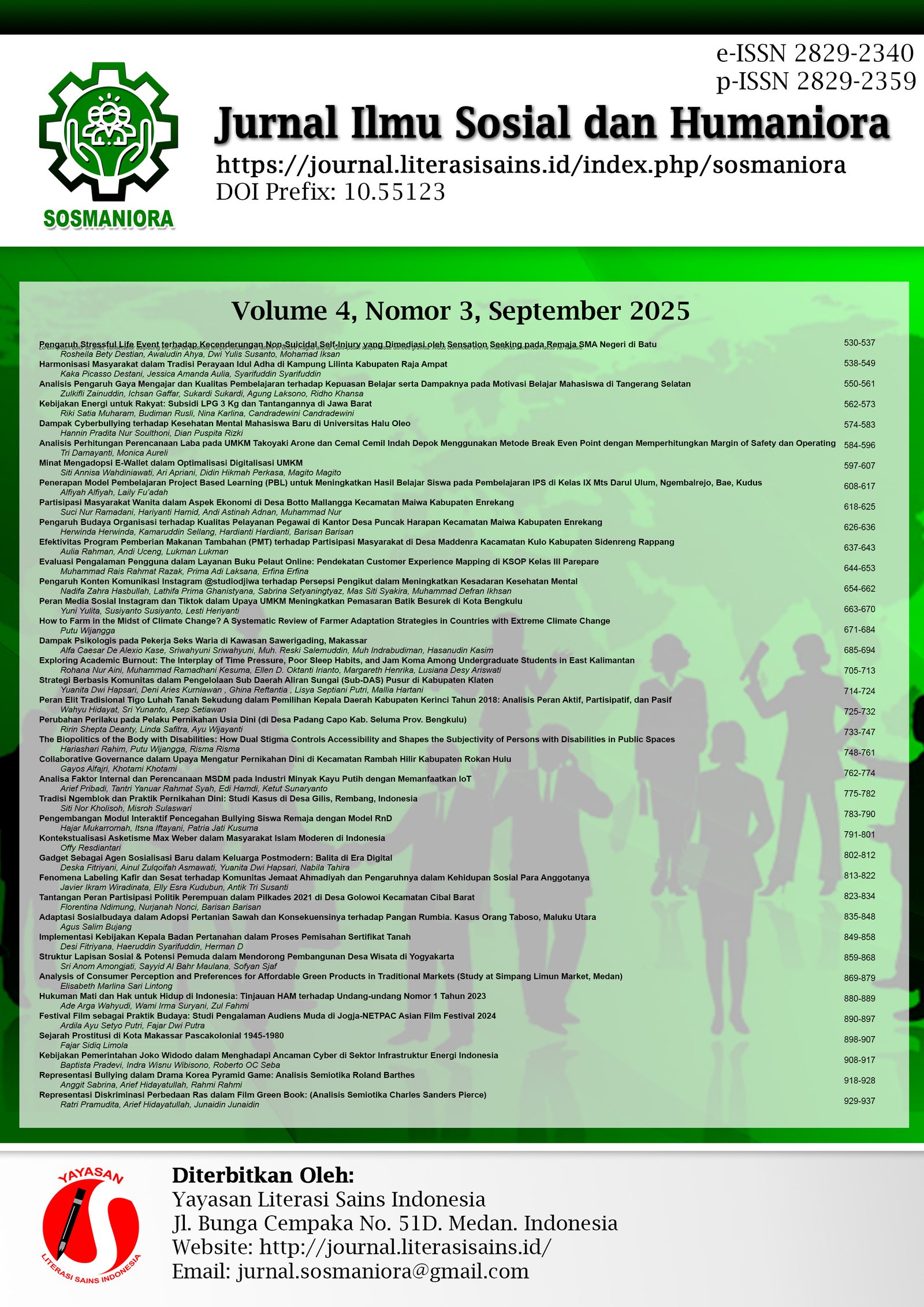
Pengaruh Konten Komunikasi Instagram @studiodjiwa terhadap Persepsi Pengikut dalam Meningkatkan Kesadaran Kesehatan Mental
DOI:
https://doi.org/10.55123/sosmaniora.v4i3.5365Kata Kunci:
Instagram, Content, Mental Health, Social MediaAbstrak
This study aims to analyze the influence of content published by @studiodjiwa Instagram accounts on followers' perceptions in increasing mental health awareness. The background of this research departs from the phenomenon of increasing use of social media, especially Instagram, as a means of delivering mental health information among the young generation of Indonesia. The approach used was quantitative with a correlational design, involving 101 respondents who were followers of the account. Data was obtained through questionnaires that measured the intensity of social media use and perception of the mental health content presented. The results showed a very strong relationship between communication content and follower perception, with a correlation coefficient value of 0.925 and a contribution of 85.5% to perception variation. These findings were analyzed using persuasive communication theory, social construction, perceptual theory, and digital health communication as a theoretical basis. This research makes an important contribution to mental health practitioners and digital content creators in designing more effective, informative, and engaging communication strategies. In the midst of the development of the digital era, the results of this study confirm the importance of using social media as an educational tool that has a positive impact on increasing awareness of mental health.
Unduhan
Referensi
Afifa, I. N., & Rahayu, P. Y. (2023). Dampak Persepsi Bagi Kesehatan Mental Individu. JPT : Jurnal Pendidikan Tematik, 4(3), 256–260. https://www.siducat.org/index.php/jpt/article/view/868
Agatha, W. L. (2022). PENERAPAN KOMUNIKASI PERSUASIF UPAYA MENGEDUKASI GANGGUAN MENTAL AKIBAT TOXIC RELATIONSHIP (Studi Pada Kind to Mind Podcast).
Arjadi, R. (2021). Layanan Kesehatan Mental Berbasis Digital di Indonesia: Riset dan Praktik (SWS Award). https://buletin.k-pin.org/index.php/arsip-artikel/850-layanan-kesehatan-mental-berbasis-digital-di-indonesia-riset-dan-praktik-sws-award
Corrigan, P. (2020). The Impact of Mental Illness Stigma on Seeking and Participating in Mental Health Care. 2. https://pubmed.ncbi.nlm.nih.gov/26171956/
Efendi, E., & Kustiawan, W. (2023). Perubahan Sosial dan Budaya Akibat Media Instagram bagi Kalangan Mahasiswa di Kota Medan. Jurnal Ilmiah Wahana Pendidikan, Februari, 9(3), 164–172. https://doi.org/10.5281/zenodo.7613705
Fransisca Mira Widyasari , Elsie Oktivera, F. W. W. (2023). Pengaruh Terpaan Informasi Kesehatan Mental terhadap Sikap Followers di Media Sosial Instagram.
Hadhinoto, P. S., & Oktavianti, R. (2020). Komunikasi Persuasif Tentang Kesehatan Mental Melalui Komik Digital (Studi pada Akun Instagram @petualanganmenujusesuatu). Prologia, 3(2), 334. https://doi.org/10.24912/pr.v3i2.6355
Julhamdani, F., & Trianti, E. (2024). Peran Teknologi dan Media Sosial dalam Membentuk Dinamika Kesehatan Mental Berdasarkan Perspektif Islam. Journal on Education, 06(02), 11448–11463.
Kanda, A. S., & Firdaus, E. (2024). Pengaruh Konten Self-Healing Di Instagram Terhadap Kesehatan Mental Generasi Z Di Kota Bandung. Jurnal Ilmiah Ekonomi Dan Manajemen, 2(2), 34–38.
Khan, N. (2020). Cultural Representations. In A Cultural History of Hair in the Modern Age. https://doi.org/10.5040/9781474206013.0012
Law, T. (2025). Instagram Mental Health Lawsuit. https://www.torhoermanlaw.com/social-media-mental-health-lawsuit/instagram-mental-health-lawsuit/
Longhofer, W., & Winchester, D. (2021). Social theory re-wired: New connections to classical and contemporary perspectives: Second edition. In Social Theory Re-Wired: New Connections to Classical and Contemporary Perspectives: Second Edition. https://doi.org/10.4324/9781315775357
Mental, G. B. D., & Collaborators, D. (2022). Global, regional, and national burden of 12 mental disorders in 204 countries and territories, 1990–2019: a systematic analysis for the Global Burden of Disease Study 2019. The Lancet Psychiatry, 9(2), 137–150. https://doi.org/10.1016/S2215-0366(21)00395-3
Nasir, M. (2025). Strategi Penggunaan Media Digital untuk Kesehatan Mental Pelajar di SMA Al-Khairiyah Cilegon. 02(03), 236–246.
Petty, R. E., & Cacioppo, J. T. (2020). The elaboration likelihood model of persuasion. Advances in Experimental Social Psychology, 19(C), 123–205. https://doi.org/10.1016/S0065-2601(08)60214-2
Pustaka, K., & Dasar, D. A. N. (2020). analisis kualitatif yang akan menghasilkan bagaimana penggambaran pesan Kesehatan mental pada Instagram @studiodjiwa dan @tanyapsikologi. Berry Dan Linoff, 20. http://repository.untag-sby.ac.id/5231/49/BAB II.pdf
Rachmayani. (2021). Health Communication Theory.
Sari, O. K., & Ramdhani, N. (2020). Kesehatan Mental di Era Digital: Peluang Pengembangan Layanan Profesional Psikolog. Media Penelitian Dan Pengembangan Kesehatan, 30(4), 337–348. https://doi.org/10.22435/mpk.v30i4.3311
Social, G. (2024). The Role of Social Media in Mental Health Awareness. https://www.gathersocial.co.uk/blog/the-role-of-social-media-in-mental-health-awareness
World Health Organization. (2022). Mental Health and COVID-19 : Early evidence of the pandemic ’ s impact. Scientific Brief, 2(March), 1–11. https://www.who.int/publications/i/item/WHO-2019-nCoV-Sci_Brief-Mental_health-2022.1
Unduhan
Diterbitkan
Cara Mengutip
Terbitan
Bagian
Lisensi
Hak Cipta (c) 2025 Nadifa Zahra Hasbullah, Lathifa Prima Ghanistyana, Sabrina Setyaningtyaz, Mas Siti Syakira, Muhammad Defran Ikhsan

Artikel ini berlisensi Creative Commons Attribution 4.0 International License.